In industrial automation and building control systems, communication reliability is the foundation of seamless performance. The Carlo Gavazzi Dupline system—a powerful two-wire fieldbus solution—simplifies data transmission across sensors, I/O modules, and controllers over long distances.
At the end of every Dupline network lies an essential yet often overlooked component: the Dupline DT01 Bus Terminator. This compact module ensures signal stability, noise immunity, and long-term reliability of the entire fieldbus.
This article presents an overview of the Dupline DT01 datasheet, including its electrical characteristics, installation guidelines, and application benefits. For full technical documentation, visit www.carlogavazzidupline.com.
1. Product Overview
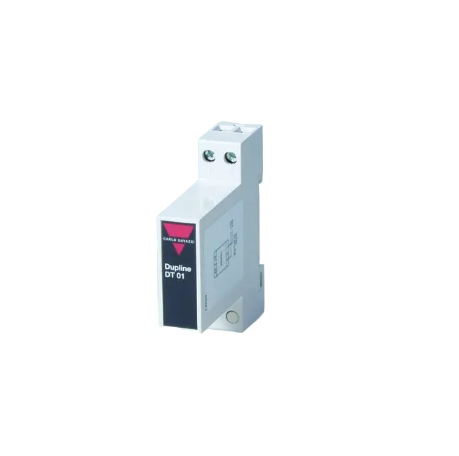
The Dupline DT01 Bus Terminator is designed to terminate the Dupline bus line at its physical end. It prevents reflections of communication signals and matches the characteristic impedance of the bus cable. This ensures clean, distortion-free communication between all connected devices in a Dupline network.
The DT01 plays a critical role in maintaining signal integrity in industrial automation, building management systems, and process control environments.
2. Key Features
- Optimized impedance matching for Dupline communication networks
- Prevents signal reflections and transmission errors
- Non-polarized 2-wire connection (D+ and D–) for easy installation
- Passive design – no external power supply required
- Compact DIN-rail mounting for quick integration
- High reliability under industrial environmental conditions
These features make the DT01 a vital accessory for achieving maximum network stability in any Dupline installation.
3. Electrical Specifications (From Datasheet Summary)
| Parameter | Description |
|---|---|
| Model | Carlo Gavazzi Dupline DT01 |
| Function | Bus line terminator for Dupline fieldbus |
| Power Supply | None required (passive device) |
| Operating Voltage Range | 8.2 V AC nominal (Dupline standard) |
| Connection Type | 2-wire, non-polarized (D+ / D–) |
| Power Consumption | < 10 mW |
| Mounting Type | DIN-rail or panel-mounted |
| Operating Temperature | -20°C to +70°C |
| Storage Temperature | -40°C to +85°C |
| Protection Class | IP20 (indoor use) |
| Dimensions | Compact enclosure, easy field installation |
Each DT01 module is designed for long-term reliability, operating continuously in industrial and commercial applications without degradation.
4. Typical Wiring and Installation
Correct installation is key to maximizing the DT01’s performance:
- Identify the end of the Dupline bus line — this is where the DT01 must be installed.
- De-energize the system before wiring.
- Strip 5–7 mm of insulation from both Dupline bus wires.
- Connect the wires to the two DT01 terminals marked “Dupline Bus” (no polarity required).
- Mount the device securely on a DIN rail or within an enclosure.
- Power up and test the network using a Dupline test unit (e.g., GTU8).
💡 Tip: For networks extended using repeaters (model GS38920000230), each segment requires its own DT01 terminator installed at the farthest point.
5. Application Areas
The Dupline DT01 Bus Terminator is used in a wide range of automation and control applications:
- Factory Automation: Ensures stable signal transfer across long production lines.
- Building Automation: Stabilizes communication for lighting, HVAC, and access systems.
- Process Control: Reduces electrical noise in harsh industrial environments.
- Energy Management Systems: Guarantees accurate data in metering and control networks.
- Infrastructure Monitoring: Provides consistent performance in large-scale distributed systems.
Its simple two-wire connection and passive design make the DT01 suitable for both new installations and system retrofits.
6. Reliability and Maintenance
The DT01 module is maintenance-free, thanks to its passive RC network design and durable construction. It does not require recalibration or power input, and its electrical characteristics remain stable throughout its lifetime.
However, to ensure long-term performance, follow these best practices:
- Periodically check that terminal connections are tight and corrosion-free.
- Protect the module from excessive moisture or vibration.
- Verify impedance balance using Dupline diagnostic tools during scheduled maintenance.
When installed properly, the DT01 can last for decades without performance degradation.
7. Integration with the Dupline Ecosystem
The DT01 Bus Terminator works seamlessly with other Carlo Gavazzi Dupline components, including:
- Gateways: SD2DUG24 for system communication to PLCs or SCADA.
- I/O Modules: G50101106, G50102206 for input/output signal management.
- Repeaters: GS38920000230 for extended network reach.
- Configuration Tools: GAP1605 for programming and diagnostics.
Together, these components form a complete Dupline fieldbus network that offers unmatched reliability and flexibility in industrial automation.
8. Compliance and Standards
The DT01 complies with international safety and EMC standards, ensuring compatibility with industrial-grade control systems:
- EMC Compliance: EN 61000-6-2 / EN 61000-6-4
- Safety Standards: IEC/EN 61010-1
- CE Marking: Confirmed for industrial use
Carlo Gavazzi’s commitment to quality and design excellence ensures that the DT01 meets or exceeds all relevant industry certifications.
9. Conclusion
The Carlo Gavazzi Dupline DT01 Bus Terminator is a compact yet powerful component that ensures network integrity, electrical stability, and long-term reliability in any Dupline system. By matching the impedance of the bus line and suppressing reflections, it guarantees smooth, error-free communication across the network.
Whether used in factory automation, building control, or energy management, the DT01 helps maintain consistent and efficient performance.
For full datasheets, wiring diagrams, and related Dupline products, visit www.carlogavazzidupline.com — your trusted source for Carlo Gavazzi Dupline fieldbus solutions.